
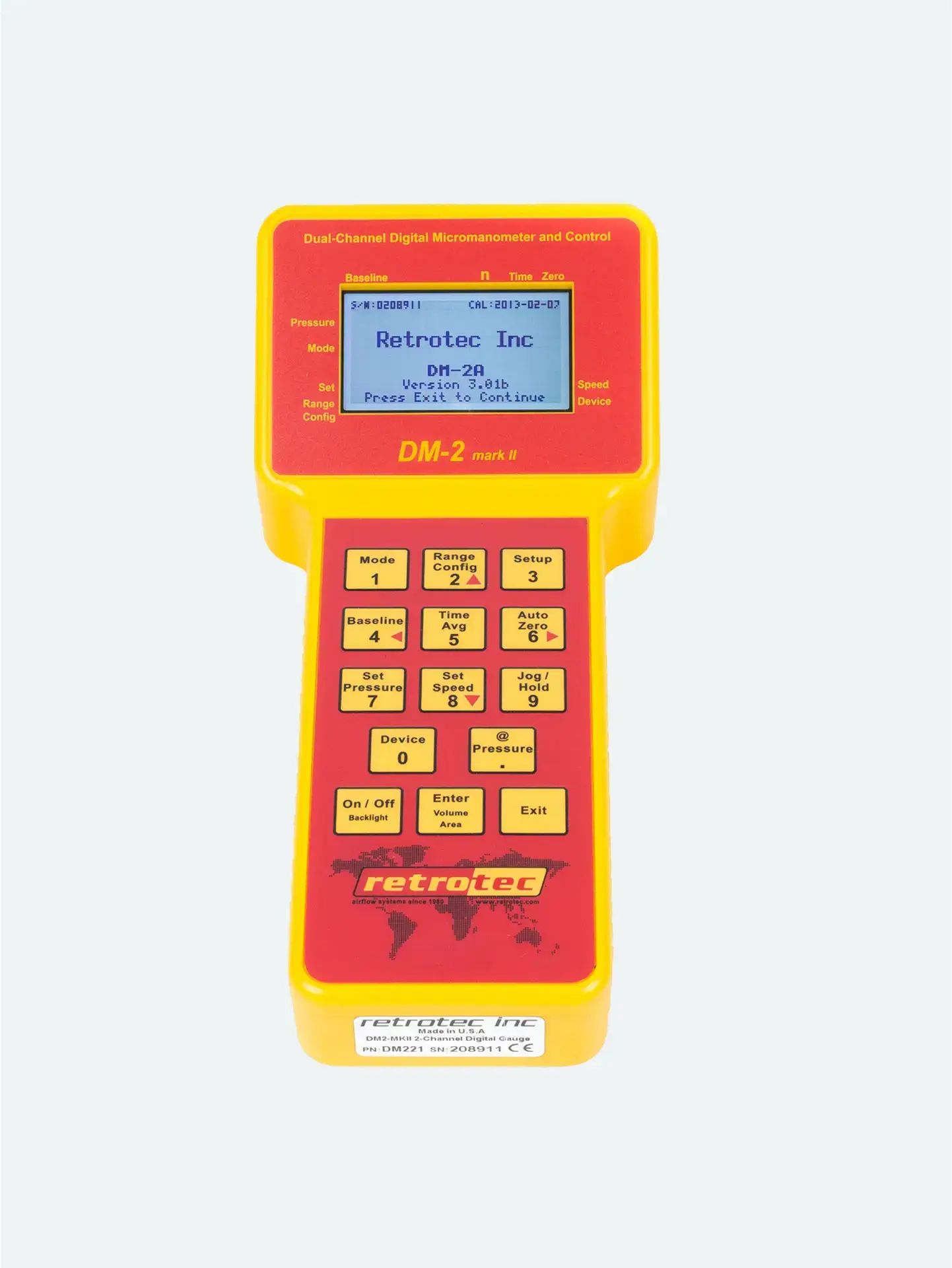
What is the difference between continuous and contained pressure?https://youtu.be/iKPlZDArqUc
Continuous Pressure
This means the gauge continuously monitors and displays pressure differences during a test—typically between inside and outside the building. It’s dynamic: as the blower door or system operates, you see live pressure readings. This mode is ideal for tracking real-time changes and ensuring conditions remain within target ranges throughout the test.
Contained Pressure
With contained pressure, you measure a pressure value and then freeze it for a moment—essentially “holding” the reading. This is useful at specific steps like baseline checks or when capturing a stable reading at a predetermined target pressure. It helps eliminate minor fluctuations so you can accurately log or input a precise value without transient noise.
When to Use Each
| Use Case | Continuous | Contained |
|---|---|---|
| Monitoring evolving conditions | Yes | No |
| Capturing a specific, stable reading | No | Yes |
| Real-time diagnostics | Yes | No |
| Data logging at isolated points | No | Yes |
Why it Matters
Accuracy in data logging: Containing a pressure ensures you record a clean, stable value—ideal for baselines or test point entries.
Live awareness: Staying in continuous mode helps you spot anomalies or pressure instability during the test setup or vent-sealing phase.
Gauge memory matters: If your device “remembers” the last mode used, a test can accidentally start in contained mode and skip ongoing monitoring—or vice versa. Always double-check your gauge mode at the start of each test.
Expert Tip
Before you begin, confirm the gauge is set to the right mode:
Continuous for flow or automated tests.
Contained for capturing clean snapshots at key test points.
